In Victorian England, as the middle class began to grow, there were more domestic servants in employment. Middle class women were able to leave all their chores or household duties to a servant. For the servants themselves, this was a good position. The servants were illiterate and from the lower class. As a domestic servant, they were able to work in a clean environment and earn a decent wage. The growth of the middle class helped employment for the lower class. If I were living in that time and from the lower class, this would be a good job. As with anything I do, I try to put my best foot forward and produce the best I can for every situation. However, I would never want to do this as employment.
The Brownings
Elizabeth and Robert Browning both wrote poetry about love. However, their poetry was very different. Elizabeth wrote about how much she loved her husband and how wonderful he was to her (in her mind). She was madly (or obsessively) in love with him and her whole world revolved around him. This love was not reciprocated. To the contrary, Robert Browning wrote of a love for someone other than his wife. His love was more of an very unhealthy possessive desire to own and control another woman. He had fallen so obsessed with this other woman that he refused to let anyone other than himself be with her. He actually killed her so that he would be the last person on her mind and the last one that she would have been with. Neither one of the Browning’s had a healthy form of love for someone else. It’s interesting to think that these two were married for anything other than a safety of “being married”.
Working class and the poor philanthropy
During the Victorian Era the way that the poor people were treated, or mistreated, was awful. The working and living conditions were so bad that many women turned to prostitution for work to feed themselves. This treatment was finally recognized by higher classes and changes were made. Some wealthy people set up homes for prostitutes so they could change their way of life. They would gain a safe place to live and work. However, that meant giving up personal freedom that some would not do. Churches became heavily involved in helping. Because religion was a major part of life, everyone was expected to participate in charitable work. Organizations were also set up that would allow people to make donations to that would in turn be used to help others.
The Lady of Shallot

Working Conditions Victorian England
The working conditions in Victorian England have some similarities and differences to today’s working conditions in England. People were and are divided into classes or groups. The poorest of people were on the bottom, and had and still have the worst working conditions. Within that group, there was and still is the group with the lowest earnings which are barely enough to live from day to day. They had and have to worst working conditions of all. Most of this group turn to workhouses where they are barely given enough food to stay alive. Families are separated within the workhouses and even children are expected to work for food and little to no money. Still today, working conditions are very poor for the lowest class or group of people in England.
Working Classes and the Poor

The image above is heartbreaking. It captured my attention right off because of the small child (appears to be a girl), alone and sad looking. The environment she is in doesn’t seem pleasant in anyway. With no adults in site, it makes me wonder if she is truly alone at the time. Perhaps the parents are out working just to provide a small amount of food. Are her parents still alive? The walkways don’t provide room for an open area for playing and running. Its a very closed off area that brings doom and gloom itself. Even the clean laundry hanging overhead blocks out natural light and air flow. Ironically, if you look down the “tunnel”, you can see the small dim light at the end.
London Slums
The slums of London are still slums today. In the Victorian Era, the overcrowding of homes and streets were that way pretty much as soon as the homes were constructed. There was no clean water around for people to bathe or drink. It wasn’t uncommon for someone to use the bathroom (all types) in the streets. Homes were extremely overcrowded and had little to no ventilation.

Without clean water, sickness ran rampant. People were always on top of each other. Homes were not built on foundations like we have today. Instead, they were built on the ground. Sometimes the ground was already moist before the walls of a home were built. The homes were so poorly built that at times there would be falling stairs and other parts of the home would be falling apart.

The buildings were built in areas called courts, sometimes named after the builders themselves, all around the city. Homes with basements usually were full of human waste that made it unbearable to tolerate. Everyone that lived in the slums barely had enough money to buy food. It was just enough to keep them from complete starvation. Sickness ran rampart throughout everyone that lived (if you call it living) in the slums. With wages so poor, women tended to work in prostitution to earn money to feed themselves and children.
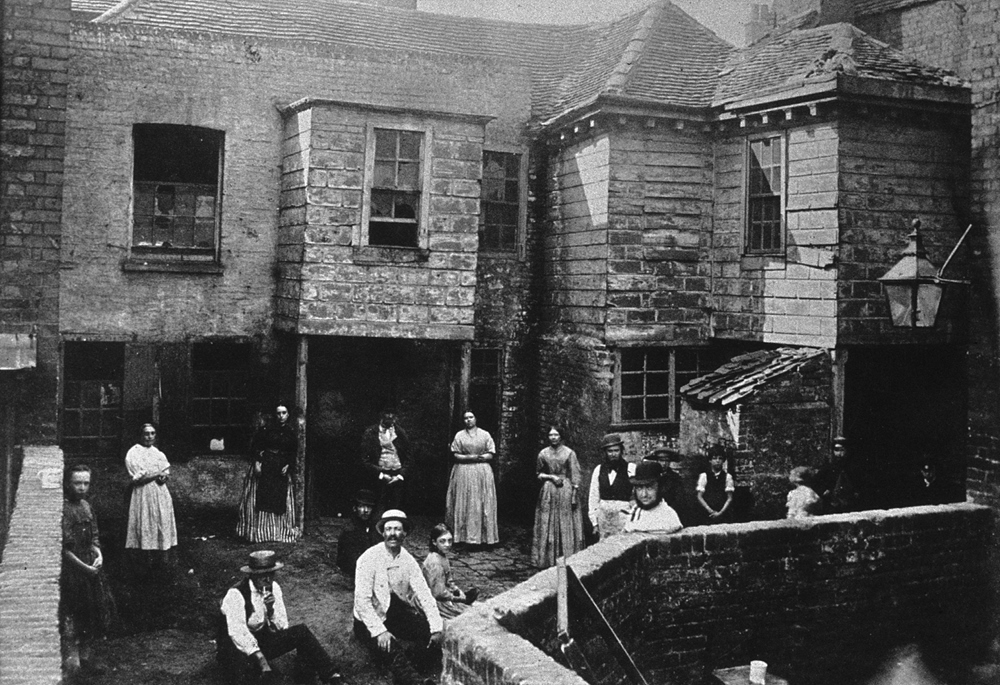
There was an attempt to clean up the slums, known as the slum clearance legislation of 1875, but it didn’t happen the way it was planned. The homes that were built were for a single middle-class families, but ended up housing several working-class families on each floor. This created the suburban slums. With the suburban slums, came more problems of drunkenness and prostitution brought much closer to the upper class areas. Unfortunately, conditions aren’t much different in London today.
Who were the Victorians?
The Victorians were like we are today in many ways. One such way is that the Victorians had political movements in which, they began having a representative government themselves. Today, we have a government where we elect people to represent our values and needs. Not only did they have changes in government that made them progressive, but they also became progressive in travel. The invention of the railway made it possible for them to travel to many destinations and enjoy several things that we enjoy today. They enjoyed going to the beach and to ball games. They were not a still society, as they were always learning and growing. This allowed for journalism to grow in which the rapid knowledge of everyday life grew with it. During this time, antiseptics were invented which truly changed the way life would be in the medical realm from that point forward. We still use antiseptics to this day.
Rules of Social Media Etiquette
There are several rules that we have for every aspect of our lives. However, when it comes to social media, most of these rules tend to be overlooked for some reason. One rule, in particular, is the rule where you need to “edit your photo post”. Posting a photo of you in a situation that could be perceived as something illegal could cause problems for you trying to get or keep a job. It may not seem like an issue at the moment, but you never know when someone will see the photo and share it with others. It doesn’t have to just be something illegal, it could even be an unpleasant or insulting photo that you have shared that get shared with someone else.
About Me

I’m a mother of four adult children furthering my education, and very excited about it. I am glad I have been given this opportunity, even at this point in life. This is my very first time blogging, and I’m not very sure how well I will do it. My children are constantly reassuring me that I can do this because I managed a home and raised them (they say successfully). I will never take my education for granted. Life is not always what we plan, but you can do things to make your path better. No one can ever take your education from you.
 Humanities101